

The energy service provider EWE and Salzgitter Flachstahl, a subsidiary of Salzgitter, have concluded a long-term agreement on the supply of green hydrogen.
This is the first major purchase agreement for hydrogen from the 320-megawatt production plant that EWE is currently building in Emden and also marks Salzgitter's first major contract with a hydrogen supplier. The plan is to supply around 10,000 tons per year via the hydrogen core network as from 2030. The contract, which runs for an initial term of seven years, will market a significant part of the first expansion stage of the plant in Emden and cover around 6.5% of SALCOS's hydrogen requirements. Further delivery volumes from EWE will therefore also be available for additional industrial partnerships.
The green hydrogen sourced from Emden is to be used in Salzgitter's SALCOS program – Salzgitter Low CO2 Steelmaking. In this context, the use of natural gas in a direct reduction plant is already capable of achieving a 60% reduction in CO2 emissions compared to the blast furnace route with coal and coke.
However, Salzgitter's long-term goal remains the virtually climate-neutral production of steel, which can only be achieved through the use of green hydrogen. Water will be produced, instead of CO2. In total, up to 150,000 tons of hydrogen per year can be used in the direct reduction plant of the SALCOS program. Salzgitter will produce around 9000 tons of this itself in a 100MW electrolysis plant on its own steelworks site.
Ramping up the hydrogen economy in Germany, however, will require additional inputs and efforts. Further the implementation of additional measures is urgently called for in order to make renewable hydrogen an internationally competitive energy source. This includes, for example, the timely and reliable extension of the electricity price compensation for electrolysers and a prompt revision of the green electricity criteria for renewable hydrogen.
With the current supply contract, however, both companies are already entering into a long-term economic commitment on the producer and customer side.
Gunnar Groebler, chairman of the executive board of Salzgitter, “With the SALCOS program, we are incrementally converting our steel production to a virtually CO2-free route. The use of green hydrogen is a key component in this context. The contract with EWE represents an important step in this direction and strengthens our role as a frontrunner in the transformation of the steel industry. Once again, we have resolved a chicken-and-egg dilemma and made an important business decision. Without initial supply contracts, no German hydrogen economy will develop. However, this agreement is also linked to an urgent appeal to policymakers. The hydrogen ramp-up still faces major hurdles. Comprehensive measures are still needed to close the cost gap and minimise business risks. Otherwise, this contract will remain an exception.”
EWE CEO, Stefan Dohler, "A functioning hydrogen economy not only protects the climate. It also strengthens Europe's industrial resilience, makes us less dependent on fossil fuel imports and helps to keep energy competitive over the long term. This agreement is a milestone, but not yet the goal. It shows that supply and demand for green hydrogen can come together. At the same time, there are initial positive signals regarding the regulatory framework. Now we have to use this momentum, initiate further industrial partnerships and build up the market step by step. This will continue to require competitive electricity prices, practicable rules for green hydrogen as well as long-term investment security. Only then will individual projects become a viable market."
EWE bundles key parts of the hydrogen value chain – from production to transportation, storage and delivery. As part of the IPCEI ‘Clean Hydrogen Coastline’ large-scale project, electrolysis, storage and pipeline infrastructures are being built in northwest Germany.
In future, the green hydrogen is to be used in Salzgitter's SALCOS program, where it will make a key contribution to virtually climate-neutral steel production. Delivery is subject to RFNBO certification.
Stefan Dohler added, "If we want individual projects to become a market, we need sensible electricity procurement criteria, functioning lead markets and investment security for large-scale storage facilities. Otherwise, companies will not be able to free up new investments in hydrogen projects.
The support of the federal government and the state of Lower Saxony made the conclusion of the contract between Salzgitter and EWE possible.
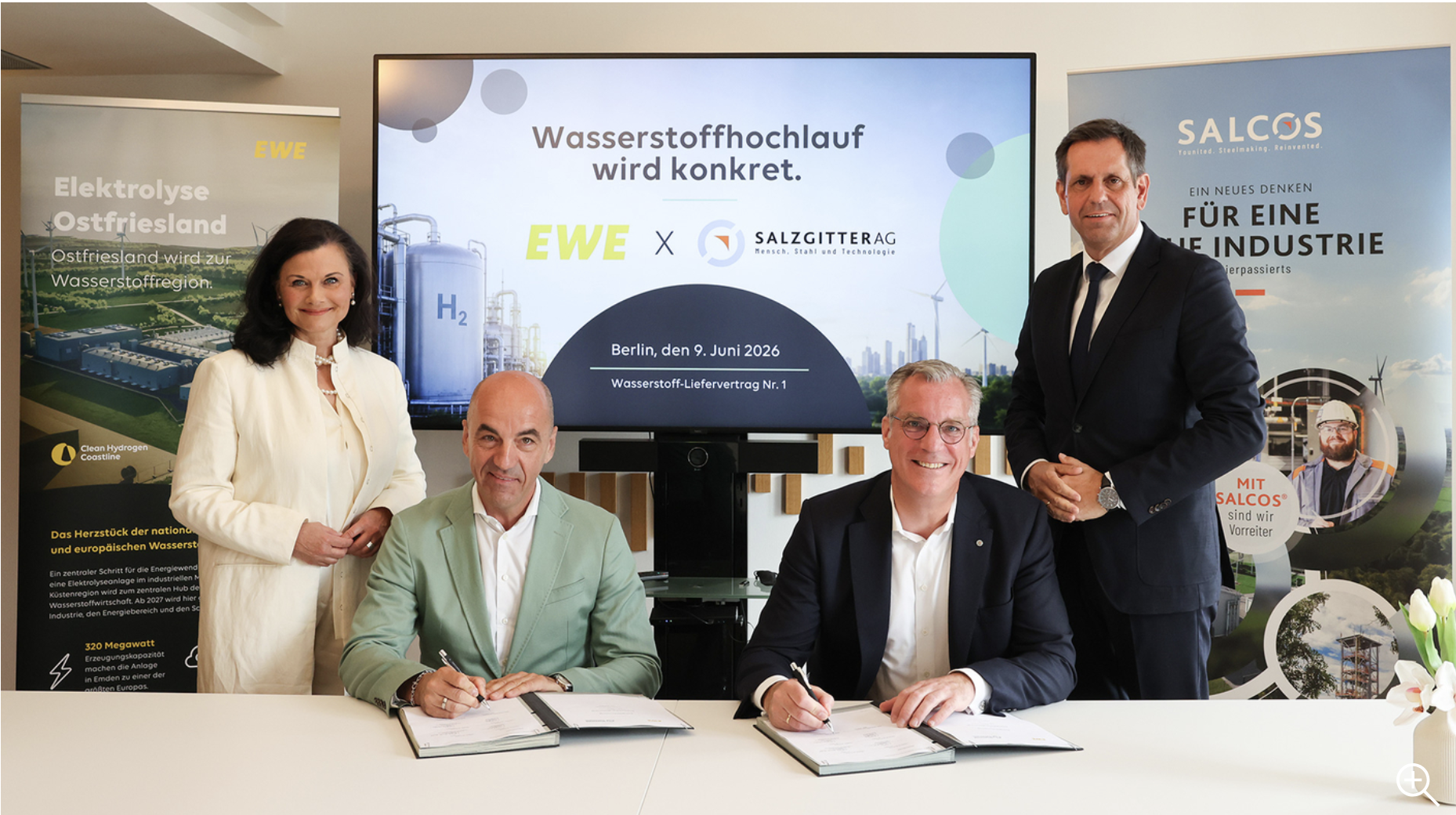
Both industry and politics support the hydrogen ramp-up (L to R): Gitta Connemann, Parliamentary State Secretary to the BMWE, Stefan Dohler, CEO EWE, Gunnar Groebler, CEO Salzgitter and Lower Saxony's Minister President, Olaf Lies, at the signing of the long-term supply of green hydrogen in Berlin
Gitta Connemann, Parliamentary State Secretary to the BMWE, said, "Today, promotion is becoming progress. And from an initial idea, a strong alliance for Germany as a business location has been created. As the contract between EWE and Salzgitter shows, the hydrogen economy is picking up speed. One company is producing, while the other is using hydrogen. This creates a cycle with a future. That is why we, as the federal government, are supporting the conversion of steel production in Salzgitter to the tune of €925m. In this way, we are securing added value and good jobs in a key industry. At the same time, we are supporting hydrogen production in Emden with €267m. After all, hydrogen must not only be used but also be produced in this country. The situation in the world makes it clear: We need more of our own energy sources. Greater independence. Greater security. In this context, hydrogen can make a vital contribution."